Review this page to find links to examples of common business and program challenges that data science is particularly adept at solving. As you are reviewing, think if any resonate with the challenges your department faces.
There are broadly 5 project typologies:
- Finding a needle in a haystack
- Reduce your backlog
- Flag things early to be proactive
- Optimize your resource distribution
- Find the best way to A/B test
Finding a needle in a haystack
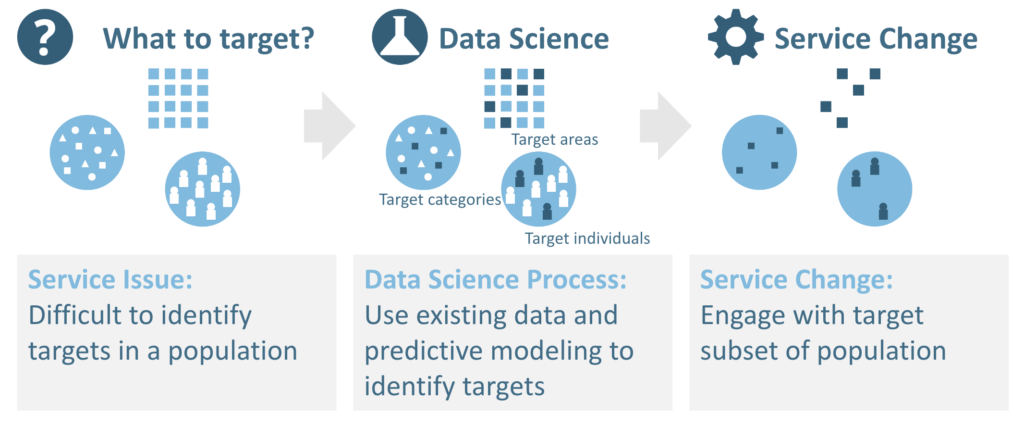
Finding a needle in a haystack is about when you have a need to identify a particular target in a population that is hard to isolate. Maybe because it is a rare occurrence or has an usual combination of characteristics. In this situation, CalData would apply a data science technique using predictive analytics to isolate those rare targets. Once the subset of the population identified as likely targets, you can engage with that subset of population.
Reduce your backlog
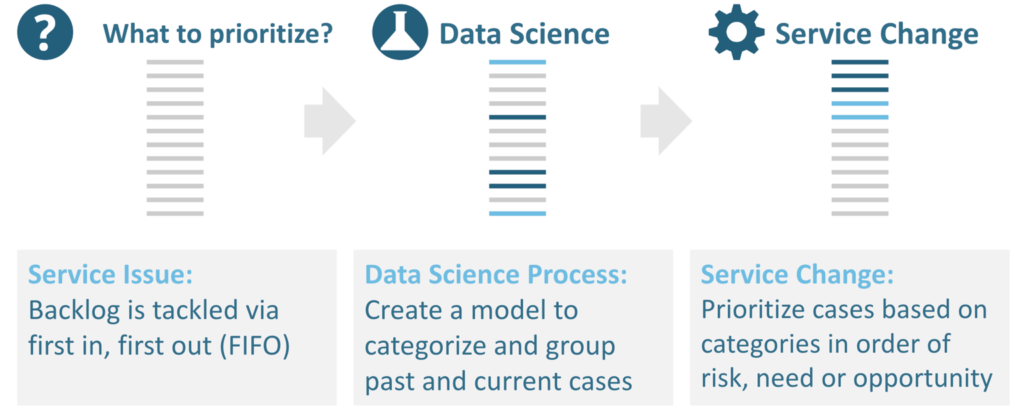
Reduce your backlog is about needing to provide a service to a list of people or places or things. Often the way the list is currently tackled is first in/first out. This often results in backlogs, where the amount of things to process exceed department capacity. In this situation, a data science technique could be applied which establishes patterns based on the data around which items in the list require more immediate attention. Once done, a service change is possible where you now have a way to prioritize your list to mitigate risk or address larger needs or opportunities.
Flag things early to be proactive
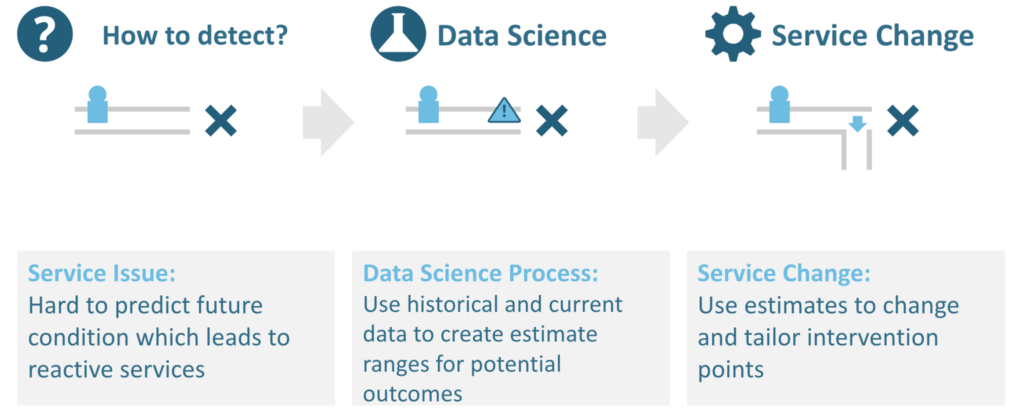
Flag things early is how to predict future conditions so you aren’t always reacting to the unexpected. The data science intervention would leverage existing data to identify ‘flags’ for things that could potential cause challenges. This information could lead to a service change to identify where and when to intervene early. The result is proactive early intervention.
Optimize your resource distribution
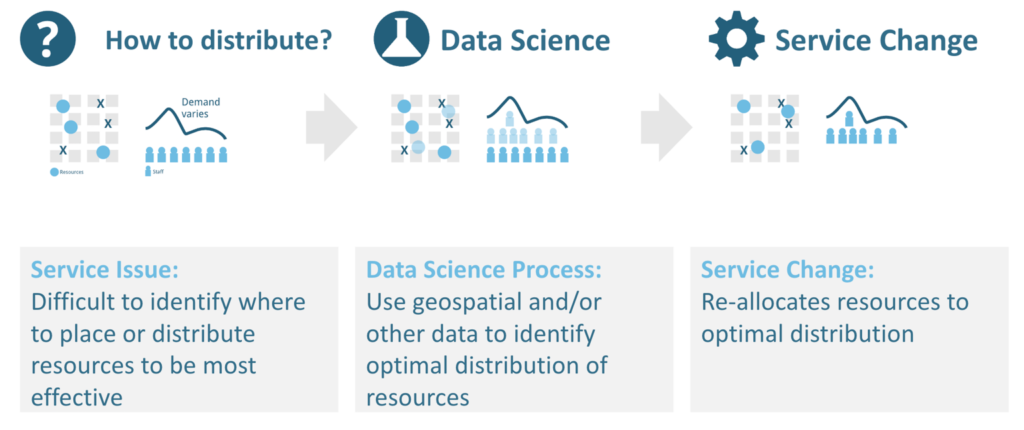
Optimize your resource distribution is about many departments have a finite set of resources they need to allocate to solve a particular challenge. Resources could be staff time, vehicles, supplies, etc. The data science intervention would use modeling to identify the optimal patterns for distribution of those resources. The department would take this information and re-allocate resources accordingly.
Find the best way to A/B test
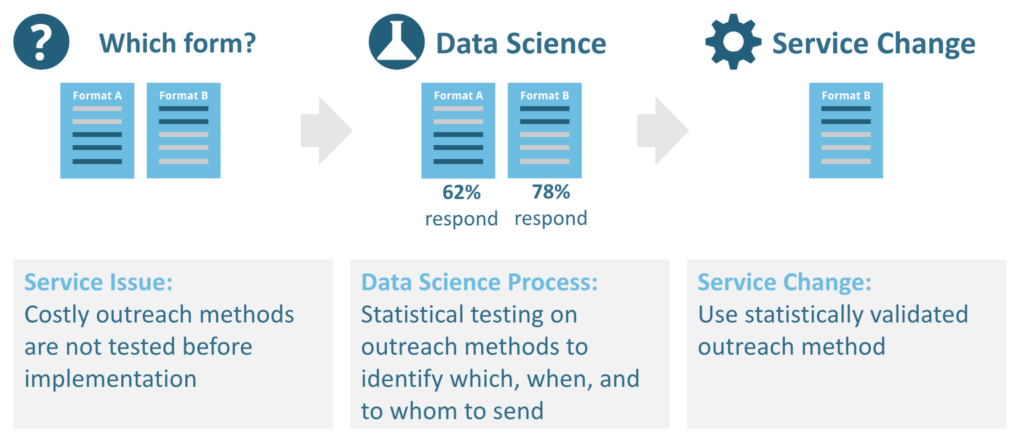
A/B testing or hypothesis testing is another common problem that data science can help with. Most common (but not only!) use is on identifying the optimal format/content of outreach methods. Data science can help you determine which message is most effective. The service change is simply selecting the most effective message.